
Overview
A modern endoscopic facelift repositions the deeper support layers through tiny incisions to refresh the brow and midface with minimal surface trauma. The effect is long lasting but not permanent, because natural aging continues while the lifted tissues settle into a more youthful position.
Table of Contents
Quick Answer: How Long Does An Endoscopic Facelift Last?
Most patients enjoy a fresher, lifted look for many years. For many, visible improvement endures in the range of five to ten years, sometimes longer with excellent skin quality, precise fixation, and good habits. The brow often holds especially well due to strong anchoring, while the midface can soften sooner because cheek tissues are heavier and more mobile. In short, if you are asking “how long does an endoscopic facelift last,” the answer is that it typically resets the clock by several years, then you age from that improved baseline.
Average Longevity (Years Vary By Patient)
Average durability is best understood as a spectrum rather than a single number. Many people see a meaningful lift for half a decade or more, and a significant subset keeps a refreshed contour closer to a decade when the operation is done on healthy tissue with stable weight and consistent sun protection.
Your personal timeline depends on what was lifted, how it was fixed, and how your skin and connective tissue respond over time. Younger patients or those with thicker dermis and better collagen often hold results longer, while those with advanced photoaging or major weight fluctuation may notice earlier softening. When you hear different answers to “how long does an endoscopic facelift last,” that variability reflects real biological differences between individuals.
What “Lasts” Really Means Vs. Normal Aging
“Lasts” does not mean freeze time. The structural changes from an endoscopic lift are durable because deeper tissues are repositioned and secured, not simply stretched at the skin. You continue to age, but from a rejuvenated starting point. Think of it as moving the hands of a clock back several years and then letting it tick forward at your natural pace. Elasticity gradually declines, facial fat pads keep evolving, and bone support subtly remodels with age. The lift’s internal support helps resist descent for years, yet day-to-day life, gravity, and sun exposure slowly reassert themselves. Understanding this distinction makes expectations realistic and helps you plan maintenance that preserves the refreshed look longer.
What Factors Affect How Long An Endoscopic Facelift Lasts
Several interlocking variables determine the staying power of your result. Some you can influence, others you cannot. Knowing them guides both your preparation and your aftercare.
Patient Age, Skin Quality, And Genetics
Intrinsic factors matter. People with robust collagen, balanced hormones, and thicker skin usually keep definition longer because their tissues hold sutures and fixation more predictably. Earlier intervention in the aging process can also stretch longevity because tissues need less relocation. Genetics set the baseline for elasticity and bone architecture around the orbit, zygoma, and brow. Extensive sun damage, advanced laxity, or a history of major weight cycling can shorten the arc of improvement. None of these are disqualifiers, but they do shape the answer to “how long does an endoscopic facelift last” for you personally.
Surgical Technique, Fixation, And Areas Treated (Brow/Midface)
Endoscopic approaches typically elevate the brow and midface in a subperiosteal or deep plane with small scalp or temporal incisions. Longevity improves when vectors follow your natural anatomy, when release of retaining ligaments is complete where needed, and when fixation is secure. Surgeons may use absorbable devices or sutures to hold tissues while biological healing creates new attachments. The brow often maintains lift very well because it can be anchored to stable bony structures. The midface can evolve sooner since it contains heavier fat pads and moves with smiling and speaking. Precision in release, redraping, and fixation is a major determinant of how long the refresh holds.
Lifestyle Influences: Sun, Smoking, Weight Change, Stress
External forces accelerate or slow tissue relaxation. Ultraviolet exposure breaks down collagen and elastin, fading results faster. Nicotine and vaping compounds impair microcirculation and wound biology, which can both blunt initial healing and hasten laxity later. Significant weight loss or gain changes cheek volume and skin tension, sometimes revealing jowls or hollowing earlier than expected. Chronic stress affects sleep and inflammation, which in turn influence collagen turnover. The same healthy choices that support skin quality before surgery continue to pay dividends for years.
Aftercare, Follow-Ups, And Healing Quality
The first months set the stage for long-term success. Elevating the head during early recovery, protecting incisions, avoiding heavy exertion until cleared, and adhering to your surgeon’s skincare and sun protocols help tissues knit in the intended position. Swelling and minor asymmetries typically settle with time and guidance. Regular follow-ups allow your surgeon to track progress, suggest adjunctive care such as medical-grade skincare or gentle energy treatments when appropriate, and address small issues before they influence the final set of the lift. Quality healing today is longevity tomorrow.
Timeline: How Long Does An Endoscopic Facelift Last From Day 1 Onward
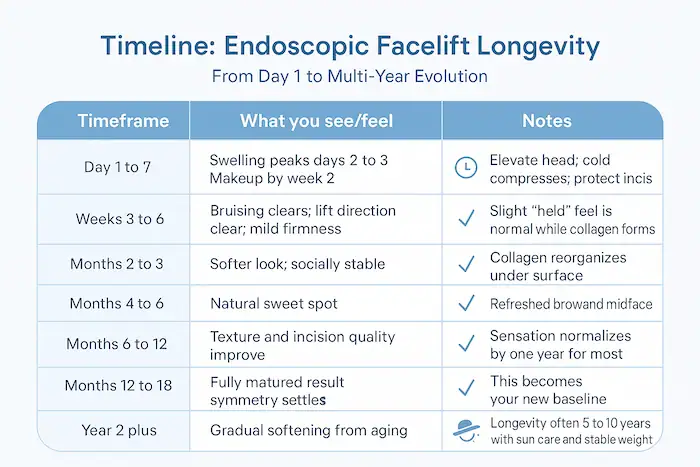
Understanding the timeline helps you predict what you will see in the mirror and why the result keeps improving as healing progresses. It also explains why different answers to the question how long does an endoscopic facelift last can all be true at different stages. The surgery repositions deeper tissues, then your body strengthens those new attachments over weeks and months. Early swelling, temporary tightness, and minor asymmetry are common and usually settle as the tissues adapt to their refreshed position.
Early Healing Vs. Final Result (Weeks To Months)
The first week is about protection and comfort. Swelling and bruising peak in days two to three, then begin to fade. Sleeping with the head elevated, using approved cold compresses, and following incision care instructions help control inflammation and protect fixation. Most patients feel presentable with light makeup by the second week, although close friends may still notice subtle swelling.
By weeks three to six, most visible bruising has resolved. You will see the direction and character of the lift clearly. The brow appears more open, the lid to cheek junction looks smoother, and the midface has better contour. Residual fullness, firmness along release lines, and small stitches under the skin can create a slightly “held” feel, which is normal while new collagen forms.
From two to three months onward, swelling continues to refine. The lifted areas soften as edema clears and microscopic scar tissue matures. If you are asking how long does an endoscopic facelift last in terms of a stable day to day look, most people feel socially invisible as surgery patients by this stage. However, the result is still getting better beneath the surface because collagen is reorganizing and the body is reinforcing the lifted position.
How Results Hold Up Over The First 12–18 Months
Months four to six often feel like the sweet spot when the face looks refreshed and natural. This period is when most patients say they “recognize” their younger self. The brow arch sits at a balanced height without a surprised look, and the midface no longer looks tired. Between six and twelve months, collagen remodeling improves incision quality and texture. Sensory changes that some people notice early on typically normalize. If minor swelling or firmness lingers in deeper planes, it usually settles by the one year mark.
Between twelve and eighteen months, the outcome is considered fully matured. Any residual asymmetry tends to balance out as soft tissues relax into the vectors set during surgery. This window is also when the long term answer to how long does an endoscopic facelift last becomes apparent for you. Patients with excellent skin quality and stable weight often find that the twelve to eighteen month look closely mirrors years two and three.
Multi-Year Evolution And When Softening Is Typically Noticed
After year two, aging resumes from that improved baseline. Gravity, facial animation, and ongoing collagen loss gradually soften the lift. Many people notice the earliest signs of change in the midface because cheek fat pads are mobile and respond to weight variation. The brow often remains well positioned longer because fixation is anchored to stable structures and the soft tissues above the brows are lighter.
Common patterns include a gentle return of the lid to cheek shadow, slightly deeper nasolabial folds, and early jawline relaxation. This does not mean the surgery “wore off”. It means you are now several years older, yet still ahead of where you would have been without the lift. For a large portion of patients, visible refresh remains meaningful for five to ten years, sometimes longer when lifestyle and skin care are optimized. That range illustrates why the question how long does an endoscopic facelift last is best answered with a timeline rather than a single number.
How To Make An Endoscopic Facelift Last Longer
You cannot stop time, but you can slow the visible effects of aging on your refreshed features. The goal is simple. Protect the collagen you have, support healthy tissue turnover, and avoid habits that undo surgical work. The following strategies are practical and evidence informed, and they extend the value of your investment by keeping the lifted contours crisp for as long as possible.
Daily Skincare And Sun Protection To Preserve Results
Ultraviolet exposure is the top extrinsic driver of collagen breakdown. Apply a broad spectrum sunscreen with a minimum SPF of 30 every morning, including the temples, hairline, and around the eyes where the brow and midface work was performed. Reapply when outdoors. Add a wide brim hat and sunglasses to reduce squinting and to protect periocular skin.
Pair sun safety with a simple morning and evening regimen. A gentle cleanser, antioxidant serum in the morning, and a retinoid or retinol in the evening are a reliable foundation. Vitamin C serums help neutralize free radicals, which preserves collagen. Retinoids encourage cell turnover and support dermal remodeling that keeps the surface smooth over your lifted framework. Moisturizers with ceramides and hyaluronic acid maintain barrier health, which helps the skin look supple rather than lax.
Professional skincare guidance also matters. Medical grade peels, light resurfacing, or non ablative fractional treatments can be scheduled once you are fully healed to improve texture without affecting fixation. The objective is not to do more, it is to do the right things consistently so that your skin ages slowly over the youthful structure the surgery created.
Healthy Habits (Sleep, Nutrition, Weight Stability)
Sleep is the unsung hero of longevity. Aim for seven to eight hours with good sleep hygiene. Elevate your head on operative nights when advised, then transition to your usual position once cleared. Quality sleep supports growth factors that influence collagen and wound biology.
Nutrition fuels tissue maintenance. Emphasize lean proteins for collagen synthesis, colorful fruits and vegetables for antioxidants, and adequate hydration. Stable weight is crucial. Significant gain or loss reshapes facial fat compartments and can either mask early jowling or exaggerate hollows, which shortens the perceived duration of your lift. If you are planning major body changes, discuss timing with your surgeon so surgical vectors and your goals align.
Avoid nicotine of any kind. Smoking and vaping compromise microcirculation and elastin integrity. Alcohol moderation helps too because chronic excess dehydrates tissues and worsens skin quality. Manage stress with routine exercise and mindfulness. These habits sound basic, yet they are the strongest levers you control in the equation of how long does an endoscopic facelift last.
Non-Surgical Maintenance (E.g., Neuromodulators, Fillers, Energy Devices
Thoughtful maintenance can extend the visual life of your result without adding scars or downtime. Neuromodulators reduce repetitive muscle pull that contributes to etched lines in the glabella and crow’s feet, which keeps the brow area looking smooth. Small, strategic doses are usually best after a lift because the target is refinement, not a frozen expression.
Hyaluronic acid fillers or biostimulators can restore volume in areas that were not lifted or that naturally thin with age, such as the tear trough, lateral cheek, or pre jowl sulcus. Conservative, anatomy guided placement complements surgical elevation by balancing light and shadow instead of chasing each line. Energy based devices like gentle radiofrequency or microfocused ultrasound can tighten superficial layers once healing is complete, which helps the skin envelope match the firmer foundation beneath.
Plan these treatments on a schedule tailored to your biology and goals. Your surgeon or aesthetic specialist can create a maintenance calendar that avoids overlaps with healing and spaces treatments for collagen remodeling. When used judiciously, these modalities act like routine service for a fine machine. They keep things running smoothly so your lift looks fresh longer.
Touch-Ups: When People Ask “How Long Does An Endoscopic Facelift Last For Me?
Touch-up planning personalizes the broad answer to how long does an endoscopic facelift last. Your tissues, lifestyle, and goals shape when you might consider small adjustments. The aim is to preserve a natural, rested look with minimal intervention while honoring the structure created during surgery. Most patients do not need another operation for many years. Instead, they use timely nonsurgical steps to maintain crisp contours until true laxity returns.
Signs It May Be Time To Reassess Results
Look for gentle, progressive changes rather than sudden shifts. The first cues often appear where movement and gravity are strongest. A soft reappearance of the lid to cheek shadow, mild deepening of nasolabial folds, or early blurring along the jawline are common markers. Photos taken at six, twelve, and eighteen months provide an objective reference. If current images show consistent softening compared with your one year baseline, it may be time to meet your surgeon. Other practical signals include heavier makeup use to hide midface shadows, sunglasses needed for brow heaviness rather than sun, or an urge to lift the cheeks when you smile. A professional exam distinguishes normal evolution from changes that respond well to a small refresh.
Minor Refresh Vs. Surgical Retightening: Longevity Considerations
A minor refresh maintains the surgical win. Neuromodulators smooth dynamic lines that can make the brow look tired. Strategic fillers or biostimulators restore targeted volume where age related hollowing reduces lift visibility. Gentle energy devices tighten superficial layers to help the skin match the firmer foundation beneath. These steps are quick, repeatable, and extend how long an endoscopic facelift lasts visually without resetting recovery.
Surgical retightening is reserved for structural laxity that nonsurgical tools cannot correct. It is more likely after several years when collagen loss and ligament relaxation exceed what energy devices can address. The benefit of the endoscopic approach remains, since tissues were originally repositioned in deeper planes. A secondary endoscopic lift or a tailored hybrid technique can refine vectors, sharpen the midface, and re secure the brow. The decision depends on anatomy, time since the first procedure, and your goals. Thoughtful timing ensures each step adds value rather than overlap.
FAQs About How Long An Endoscopic Facelift Lasts
Understanding key details helps set realistic expectations and keeps the focus on long term satisfaction.
Is An Endoscopic Facelift Permanent?
No cosmetic lift is permanent because aging continues. What the procedure does is move you to a younger baseline by elevating and fixing deeper tissues. From there you age naturally at your own pace. Many patients retain a visible benefit for five to ten years, sometimes longer with excellent skin care, sun protection, and weight stability. Even when softening appears, you are typically ahead of where you would have been without surgery.
Does An Endoscopic Facelift Last As Long In The Brow As In The Midface?
The brow commonly maintains improvement for a long time because fixation can be anchored to stable bony structures and the forehead soft tissues are lighter. The midface can soften sooner since cheek fat pads are heavier and move with facial expression. This difference does not mean one area failed. It reflects normal biomechanics. Smart maintenance, including small doses of neuromodulators around the brow and volume support along the lid to cheek junction, helps both regions age in sync.
Do Exercise And Weight Changes Shorten How Long It Lasts?
Healthy exercise supports longevity by improving circulation, sleep, and stress control. Very intense activity in the first weeks should wait until your surgeon clears you, since early strain can increase swelling. After healing, exercise is positive. Large weight swings can shorten perceived duration by altering facial fat compartments. Significant loss may accentuate hollows and reveal jowling sooner. Significant gain can blur midface definition. Stable, healthy weight helps preserve the contour established by surgery.
How Long Until The Result Is Stable And Not Changing Day-To-Day?
Most people feel presentable at two to three weeks, but refinement continues. By two to three months, day to day changes are small and the look is socially stable. True maturation often completes between twelve and eighteen months as swelling resolves and collagen remodels around the lifted tissues. That is when your personal answer to how long does an endoscopic facelift last becomes clear, since the fully settled result now serves as your new baseline for the years ahead.