
Overview
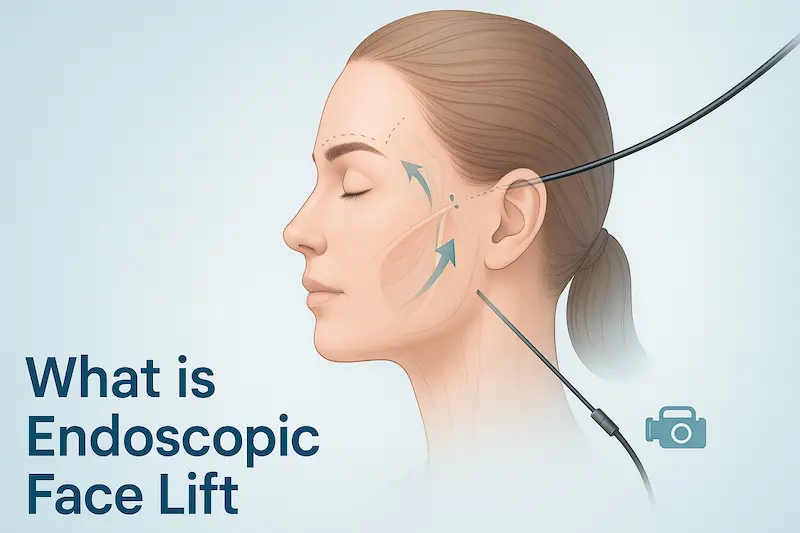
An endoscopic face lift is a modern facial rejuvenation technique that uses tiny cameras and small incisions to lift and reposition deeper facial tissues with precision. If you are searching for a clear answer to the question What is Endoscopic Face Lift, think of it as a way to refresh the upper and midface by working beneath the skin through discreet entry points rather than a long surface incision.
Table of Contents
Definition of Endoscopic Face Lift
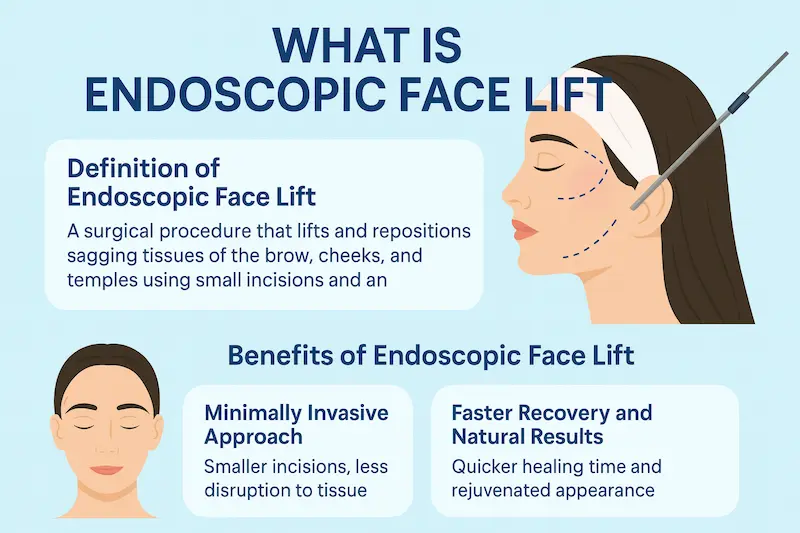
An endoscopic face lift is a surgical procedure designed to elevate and stabilize the tissues that create brow heaviness, upper eyelid hooding, and sagging in the temples and midface. Instead of opening a long incision along the hairline or around the ear, the surgeon works through a few short openings hidden within the scalp or along natural creases. A slender camera called an endoscope is inserted to provide a close view of the muscles, ligaments, and fat pads that shape the upper third and the midface.
This approach focuses on restoring youthful support where it has weakened over time, which can soften frown lines between the brows, reduce a tired brow position, and lift the cheek area for a smoother transition from lower eyelid to cheek.
Because the method targets the layers beneath the skin, results come from structural repositioning rather than surface pulling. That is why the look often appears rested and harmonious.
Patients and surgeons value this technique for candidates who are most concerned with brow descent, a flat or fallen cheek contour, and early jowling that originates from midface descent rather than heavy neck laxity. The procedure is frequently tailored to the individual. Some patients benefit from an endoscopic brow lift only, while others combine it with a midface elevation through the same small access points to address the cheek and the area beside the nose. The goal is to restore the natural direction of youthful support rather than to stretch the skin.
When people ask What is Endoscopic Face Lift, they also want to know how it fits among other options. Compared with a traditional full face and neck lift that concentrates on jawline and neck bands, the endoscopic approach prioritizes the upper third and the midface. It can be paired with complementary treatments such as eyelid surgery or limited liposculpture of the jawline when indicated. By working internally with targeted release and suspension, the surgeon can correct the cause of heaviness while preserving normal expressions and hairline position.
How the Procedure Works
After planning and marking the vectors of lift, the surgeon creates several small openings hidden in the scalp or within natural creases. Through one opening the endoscope illuminates and magnifies the field, while other openings accept specialized instruments. The surgeon gently frees the retaining ligaments and tight tissues that hold the brow and cheek in a descended position. Once these attachments are released in a controlled way, the tissues can glide back to their youthful position without tension on the skin.
The next step is fixation. The lifted tissues are supported with sutures or small internal anchors that secure them to stable structures until healing bonds form. Because the work is performed in the deeper planes, the skin can lie back smoothly without the need for extensive trimming. This is why incision length stays short and scars are typically concealed by hair or within natural lines. Throughout the procedure the endoscope provides a magnified view that helps the surgeon identify small blood vessels and nerves, minimize trauma, and place fixation precisely.
Anesthesia is selected according to patient and surgeon preference. Many patients do well with general anesthesia, while some centers offer deep sedation for selected cases. The operation time varies with the extent of correction and whether additional steps such as eyelid refinement are included. At the end of surgery small dressings are placed. Since the skin has not been heavily undermined, swelling tends to concentrate in predictable areas around the brows and cheeks and usually settles in a steady fashion as the tissues heal into their new position.
The Role of Endoscopic Technology
Endoscopic technology is the core enabler of this technique. The endoscope carries a tiny camera and light source that project a high resolution image to a monitor. This real time view lets the surgeon operate with a level of precision that is not possible through blind dissection. Key landmarks such as the supraorbital and supratrochlear nerves in the brow, the delicate muscles that create frown lines, and the retaining ligaments along the cheek can be identified and handled with care.
The magnified image also supports selective release. Rather than loosening large regions of tissue, the surgeon can target specific attachments that contribute to descent. This targeted strategy reduces unnecessary trauma to surrounding planes and helps limit bruising. In addition, the endoscopic view guides the placement of suspension sutures or devices so that lift vectors align with the natural direction of youthful support. Proper vector design is essential for a refreshed look that avoids an overpulled appearance.
Lighting and magnification are not the only advantages. Endoscopic instruments are designed to be slim and efficient within small corridors. Suction and irrigation can be used through the ports to maintain a clear field. Some systems integrate radiofrequency or other energy tools to assist with gentle release and hemostasis. The result is a method that favors accuracy and conservation of normal tissue while accomplishing meaningful repositioning. For patients, this often translates into discreet entry points, a smoother surface due to deeper work rather than skin tension, and a return to daily routines in a timeframe that reflects the limited surface disruption.
By understanding the technology and sequence of steps, the answer to What is Endoscopic Face Lift becomes clear. It is a structural rejuvenation of the upper and midface performed through small access points with camera guidance. The approach focuses on restoring support where it was lost, protecting natural features, and setting a foundation for balanced improvement that can be tailored to individual anatomy and goals.
Benefits of Endoscopic Face Lift
Understanding the benefits helps complete the answer to What is Endoscopic Face Lift. Because the technique works through small entry points and repositions the internal support system rather than stretching the skin, it offers advantages that matter to people seeking refreshment without dramatic external signs of surgery. The approach is designed to protect natural hairlines and ear contours, camouflage scars within the scalp or creases, and allow the lifted tissues to settle smoothly. Precision is central.
The camera guidance lets the surgeon identify and selectively release the key structures that tether the brow and midface. By correcting the cause of descent, the method can soften heaviness over the outer eyelids, open the eye area, elevate the cheek for a gentler lid to cheek transition, and refine the early shadowing that makes the midface look tired. These improvements are structural, which is why the surface looks calm rather than tight.
The benefits also include a plan that can be tailored. Some individuals need a subtle brow elevation only, while others combine brow and midface support through the same access points. When appropriate, limited complementary steps such as eyelid refinement or small volume contouring can be added without changing the minimally invasive character of the operation.
Minimally Invasive Approach
The minimally invasive nature begins with the incisions. Instead of a continuous cut around the ear or along the hairline, the surgeon uses a few short openings placed to be hidden. Through these portals the endoscope and slim instruments provide a magnified view of the deeper planes where aging changes start.
The reduced surface dissection helps preserve blood supply to the skin, which supports calmer healing and lowers the chance of wide scars. Because the skin is not the primary lifting layer, there is less tension on the edges of the incisions and the hairline remains stable. For many suitable candidates this means that once early healing is complete, it is difficult for others to see where access was made.
Working internally also encourages precision. The surgeon can focus on the retaining ligaments, gliding planes, and facial muscles that influence brow position and cheek support. Targeted release prevents unnecessary disruption of healthy areas. This selectivity can reduce bruising and swelling compared with methods that rely on broad undermining.
Another advantage is control over vector design. The lift can be directed along natural lines of youthful support rather than pulled sideways, which helps expressions remain familiar. For people who ask What is Endoscopic Face Lift and wonder whether it will look obvious, the minimally invasive approach is one reason the outcome often reads as rested and balanced. Finally, the compact access points make it easier to combine the procedure with non skin tightening technologies or skin quality treatments at later stages, since the foundation has been restored from within without creating large surface scars.
Faster Recovery and Natural Results
Recovery is influenced by many factors, yet the pattern with this technique tends to favor a quicker return to daily routines. Short incisions limit surface trauma. Deeper plane work allows the skin to redrape without heavy trimming, which means less tension and usually a more predictable swelling curve.
Many people resume light activities within the first week, return to desk work soon after, and add fitness gradually as advised by their care team. The most visible signs of surgery often concentrate around the brow and cheek where the corrections were made, and these signs generally fade as internal support heals into its new position. Because the access points are discreet and the hairline is preserved, hairstyles do not need major adjustments during recovery.
Natural results are the other major benefit. The procedure repositions tissues that create expression and contour, so improvements align with how the face looked before descent. The brow lifts without an arched or surprised look when vectors are planned to mirror youthful anatomy. The midface rises to smooth the lid to cheek junction and soften nasojugal shadowing, which reads as healthy rather than pulled. Smiles remain authentic because the operation avoids excessive skin tension.
People who started by asking What is Endoscopic Face Lift often say that the best part is how friends notice they look rested without recognizing a surgical change. Longevity is supported by the fact that internal attachments are reset and fixed while new healing bonds form, so the face does not rely on stretched skin for support.
These benefits do not replace a personalized consultation. Anatomy, goals, and any combined procedures will shape both the experience and the timeline. Still, when the indications match the strengths of the method, the combination of small access points, targeted structural work, and thoughtful vector design explains why many consider the endoscopic approach a smart path to a refreshed upper and midface with a calm recovery and a look that stays true to the person.