

Overview
A face lift is a surgical procedure that restores a smoother jawline, reduces jowls, and refines the neck by lifting and securing deeper facial support layers. If you have ever typed what is face lift to understand what it can and cannot do, the short answer is that it repositions descended tissues to create a natural, rested look rather than a pulled appearance.
Table of Contents
What Is Face Lift: Definition And Purpose
A face lift, also called rhytidectomy, is a surgical method for correcting laxity and descent in the lower two thirds of the face and often the neck. Aging changes are driven by reduced collagen, gravitational descent of the superficial musculoaponeurotic system, weakening of retaining ligaments, and shifts in fat compartments. Skin treatments can improve texture, yet they do not restore firm structural support. The purpose of a face lift is to reposition the framework that gives the face its youthful contour and then redrape skin without tension.
People often ask what is face lift because they want clarity on scope. It is not a treatment for every sign of aging. A face lift is designed for jowls that blur the jawline, marionette shadows beside the chin, loose submental tissue under the chin, and a lax neck with banding. It can soften the nasolabial region by elevating the descended midface, although deeply etched folds may still require adjunctive treatments.
It does not smooth forehead lines or raise drooping brows, which are addressed with brow or eyelid surgery. It does not replace the need for good skin care, sun protection, or resurfacing for fine lines. The central aim is structural renewal so the face looks like a refreshed version of itself.
A modern face lift focuses on deeper layers rather than simply pulling skin. Surgeons elevate and mobilize the support layer, restore youthful vectors of tension, and then lay the skin back down so it sits comfortably. This approach helps results look natural and last longer because the lift relies on internal support rather than tight skin. When counseling patients, surgeons explain that a face lift improves contour and shadow patterns that signal age to the eye. The goal is harmony, not overcorrection.
How A Face Lift Addresses Visible Signs Of Aging
Aging produces a predictable pattern. The cheek fat pads descend, jawline ligaments loosen, and the platysma in the neck can separate into vertical bands. These changes create jowls, a squared lower face, and a heavier neck profile. A face lift addresses these elements by freeing and repositioning the support layer so that soft tissue is moved back where it came from, along vectors that match youthful anatomy. When that foundation is restored, light reflects differently off the face. The jawline appears cleaner, the pre jowl hollow fills in, and the transition from lower eyelid to cheek looks smoother when midface support is improved.
Repositioning also reduces shadowing that reads as tired or stern. For example, by restoring cheek support, the groove beside the nose can appear less deep even without filling. By resuspending the platysma and tightening neck support, the angle between chin and neck sharpens, which gives a slimmer and more athletic profile. Because the lift is applied to the internal framework, the skin can be closed without tension, reducing the risk of a drawn or windblown look.
Patients sometimes assume pulling the skin tighter is the solution. In reality, the key is controlled movement of the deeper layer and careful redistribution of laxity. When performed with an eye for balance, the procedure does not change a person’s identity. Instead, it restores familiar features that have gradually drifted. This is why many people hear comments like you look rested rather than questions about surgery.
Facial Areas A Face Lift Typically Targets
A standard face lift focuses on the lower face and neck, with helpful effects on the midface depending on technique.
- Jawline and jowls. The most visible improvement is the return of a clear mandibular contour and the reduction of soft tissue that hangs over the jaw.
- Marionette region. Lifting reduces the downturned look beside the mouth by improving support along the jaw and lower cheek.
- Submental area and neck. Tightening deep neck tissue and addressing the platysma bands refine the under chin angle and reduce fullness or banding.
- Midface support. Certain techniques can elevate the cheek fat pads enough to soften the lid to cheek junction and improve cheek projection, although true lower eyelid concerns may still need eyelid surgery.
Areas outside the scope include the forehead, glabellar frown lines, and lip lines, which are usually treated with complementary procedures or skin therapies. Understanding these boundaries helps set accurate expectations and clarifies what is face lift in practical terms. The operation restores structure and contour where descent is the main problem, while other modalities address skin quality, fine lines, and volume loss.
Main Surgical Approaches
Understanding technique helps answer what is face lift in practical terms. Modern surgeons focus on lifting the deeper support layers so the skin can settle without tension. Three common approaches are outlined below.
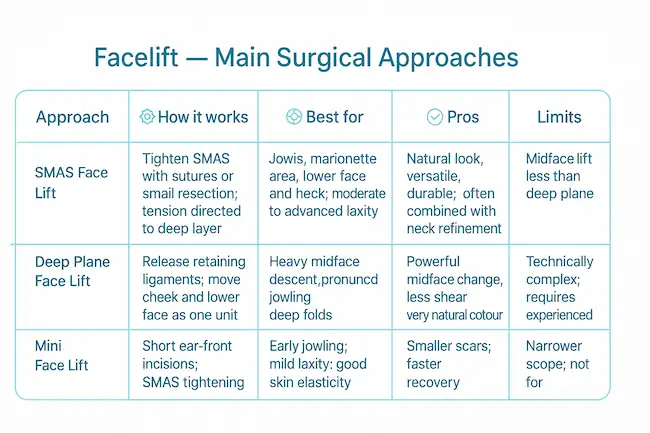
SMAS Face Lift (Superficial Musculoaponeurotic System)
The SMAS is a fibromuscular sheet that connects facial expression muscles to the skin. In a SMAS face lift, the surgeon elevates skin just enough to access this layer, then either plicates it with sutures or resects and advances a small strip before fixing it to sturdier tissue. Redirecting tension into the SMAS restores youthful vectors along the jaw and lower cheek, which reduces jowls and improves the marionette region. Because the lift is carried by the deeper layer, the skin is redraped without excessive pull, which supports a natural look.
SMAS techniques are versatile and can be tailored to mild, moderate, or more advanced laxity. They are often combined with neck work to sharpen the under chin angle when banding or fullness is present. For many patients who ask what is face lift as it applies to the lower face, a well executed SMAS approach provides durable, balanced correction.
Deep Plane Face Lift
A deep plane face lift works beneath the SMAS by releasing key ligaments and mobilizing the cheek and lower face as a connected unit. By freeing the retaining ligaments, the surgeon can elevate descended midface fat pads and restore cheek projection more effectively, which can soften the lid to cheek junction and improve nasolabial depth. The composite movement means less shear between skin and the underlying tissues, so bruising can be favorable while achieving significant repositioning.
Deep plane lifting is particularly helpful for patients with heavy midface descent or pronounced jowling. It requires precise knowledge of facial nerve branches and blood supply, and in experienced hands it yields powerful yet natural changes. If your main concern is midface flattening with deep folds, your consultation may include a discussion of whether a deep plane strategy better matches your goals.
Mini Face Lift (Short Scar Techniques)
A mini face lift uses shorter incisions, typically around the front of the ear, with focused tightening of the SMAS and limited neck work. It aims to refresh early jowling and mild laxity in patients who still have good skin elasticity and minimal neck changes. The benefits include smaller scars and a quicker recovery compared with full lifts.
The trade off is narrower scope. A mini lift is not intended to correct advanced neck banding or significant midface descent. When chosen for the right candidate, it can delay the need for a more extensive procedure while maintaining a clean jawline. People who search what is face lift often discover that mini techniques are best viewed as scaled solutions for early signs rather than substitutes for comprehensive lifting.
A mini face lift uses shorter incisions, typically around the front of the ear, with focused tightening of the SMAS and limited neck work. It aims to refresh early jowling and mild laxity in patients who still have good skin elasticity and minimal neck changes. The benefits include smaller scars and a quicker recovery compared with full lifts.
The trade off is narrower scope. A mini lift is not intended to correct advanced neck banding or significant midface descent. When chosen for the right candidate, it can delay the need for a more extensive procedure while maintaining a clean jawline. People who search what is face lift often discover that mini techniques are best viewed as scaled solutions for early signs rather than substitutes for comprehensive lifting.
Ideal Candidates And Timing
The ideal time for surgery is less about a birthday and more about visible patterns of descent, skin quality, and lifestyle factors that influence healing. Objective signs guide the decision, and so do personal goals about freshness and facial harmony.
Clinical Signs You May Benefit From A Face Lift
Common indicators include persistent jowls that blur the jawline even at a healthy weight, down turning at the corners of the mouth that deepens marionette shadows, and a relaxed neck angle with banding or fullness under the chin. Patients may notice makeup settling into creases along the jaw or that photos highlight a heavier lower face compared with earlier years. Good candidates typically have realistic expectations, stable weight, and a commitment to sun protection and skin care.
Nonsurgical options can help texture and volume, yet they cannot re create deep support. When the internal framework has shifted, surgical repositioning is the reliable way to restore contour. If you find yourself repeatedly asking what is face lift and whether it fits your concerns, a consultation that includes photographic analysis and a tissue pinch test around the jaw can clarify candidacy.
When A Face Lift May Not Be Appropriate
Surgery may be deferred if there are uncontrolled medical conditions that increase anesthesia or wound risk, such as poorly managed hypertension, diabetes with high A1C, or bleeding disorders. Active smoking impairs microcirculation and raises the chance of skin edge compromise, so cessation before and after surgery is strongly advised. Individuals seeking correction for issues outside the procedure’s scope, such as forehead lines or upper eyelid hooding, may be better served with complementary procedures. Significant weight fluctuation planned in the near future can also alter results, since major gain or loss changes facial fullness and tension on repairs. Finally, if expectations center on pore size, pigment, or very fine lines, resurfacing and skincare are more appropriate first steps.
Procedure Overview (Step By Step)
Although details vary by technique and anatomy, most face lift operations share several core stages that prioritize safety, precision, and comfort.
Anesthesia And Incision Placement
Patients usually receive general anesthesia or local anesthesia with sedation, selected based on health profile and planned scope. Vital signs are monitored continuously, and local anesthetic with epinephrine is used to reduce bleeding during dissection.
Incisions are designed to blend with natural creases around the ear, often curving inside the tragus or just in front of it, then continuing around the earlobe and into the hairline. For neck work, a small incision may be placed under the chin to access the platysma and submental fat. Careful planning of incision location preserves hairline position and allows tension to be distributed on deeper layers rather than on the skin edges. This planning step is central to natural scar camouflage and long term comfort.
Tissue Repositioning And Skin Redraping
After elevating the skin to the extent required, the surgeon works on the SMAS or deeper plane, releasing retaining ligaments where appropriate and shifting tissue back to its youthful position. In the neck, the platysma may be tightened centrally and laterally to recreate a defined cervicomental angle. Hemostasis is secured throughout to limit postoperative bruising. Once the deeper support is rebuilt, the skin is gently laid back without stretch and trimmed to fit the new foundation. This sequence explains why modern lifts look rested rather than tight. The lift comes from internal suspension, not from pulling the skin.
Closure And Immediate Post Op Care
Skin is closed with fine sutures and staples where appropriate, and small drains may be placed to prevent fluid accumulation in select cases. A light, supportive dressing is applied to limit swelling and protect the incisions. In recovery, nurses monitor comfort, nausea control, and blood pressure, while the head is elevated to reduce edema. Written instructions cover medication timing, cold compress use during the first day, and activity limits that protect the repair. Most patients return home the same day with a follow up scheduled within the first week to remove any drains and assess early healing. Clear communication during this period reinforces what to expect and helps you participate in a smooth recovery.
Recovery And Aftercare
Healing is a process with predictable stages that you can prepare for in advance. A thoughtful plan for rest, mobility, and incision care helps the lift settle into a natural shape. When people ask what is face lift in practical life, they are also asking how the first days feel, when swelling peaks, and how long it takes to look social again.
Typical Healing Timeline (Days To Weeks)
Day 0 to Day 2. Expect a snug feeling along the jawline and neck, along with swelling that is most noticeable in the morning. Keeping the head elevated, using approved cold compresses during the first day, and taking medications on schedule improve comfort. Some patients have small drains for the first day. These reduce fluid collection and are removed at an early checkup.
Day 3 to Day 7. Bruising often appears along the lower cheek and under the chin, then begins to fade through yellow and green tones. Sutures around the ear are usually removed between Day 5 and Day 7, while small staples in the hairline may remain a little longer. Light walking is encouraged to support circulation. Avoid bending, heavy lifting, and vigorous housework that can increase facial pressure.
Week 2. Many people feel ready for desk work or video calls with concealer once bruising softens. Swelling is still present, especially at sunrise, and the lower face may feel heavy or numb. The tight sensation is a sign of internal support settling. Gentle scar care typically begins after incisions are closed, as advised by the surgeon.
Weeks 3 to 6. Most social swelling recedes, the jawline looks cleaner, and the neck angle sharper. Areas near the earlobe and under the chin can hold firmness longer, which is normal. Exercise intensity increases gradually if the surgeon agrees. Tingling or itchiness may occur as small nerves wake up.
Months 3 to 12. Final refinements come from scar maturation and soft tissue remodeling. Scar color fades from pink to a tone that blends with surrounding skin. Sensation continues to recover. By this stage the result reads as your face rather than a recent procedure.
Swelling, Bruising, And Scar Maturation Tips
Sleep with the head elevated for at least the first week. Use prescribed medications as directed, and avoid over the counter products that increase bruising unless cleared by your surgeon. A balanced diet with adequate protein supports tissue repair. Hydration and limited sodium help manage water retention. Once approved, a gentle lymphatic drainage routine guided by your care team can reduce lingering puffiness.
For scars, follow the exact timing given by your clinic. Typical steps include silicone gel or sheeting after the skin has sealed, sun protection with broad spectrum sunscreen, and avoiding direct heat on fresh scars. Massage is sometimes introduced after several weeks to soften firmness along the incision path. With consistent care most patients find that scars hide well in hairline curves and ear contours. These habits are simple, yet they are a major reason outcomes look refined at one year.
Results, Longevity, And Maintenance
A face lift restores structure and light reflection patterns that signal youth. The improvement is visible early, then becomes more natural as swelling recedes. Longevity depends on technique, tissue quality, lifestyle, and the normal pace of aging.
How Long Results Usually Last
Most patients enjoy a refreshed jawline and neck for many years. A practical way to think about durability is that the clock is turned back, then it resumes. For many, the meaningful lift is apparent for five to ten years.
Those with thicker dermis, careful sun habits, and stable weight often sit toward the longer end of that range. Lifts that include deep support of the SMAS or deep plane usually age more gracefully because the skin is not carrying the tension. Retention of a crisp cervicomental angle also depends on maintaining posture and avoiding large weight swings that change neck fullness. If you are researching what is face lift with an eye to longevity, think of it as a structural reset that benefits from smart maintenance.
Habits That Help Preserve Your Outcome
Daily sunscreen with generous application across the face, ears, and neck is the single most effective habit. Sun exposure weakens collagen and pigment balance, which accelerates laxity and dulls skin quality. A routine that includes a retinoid or retinol, vitamin C, and barrier supporting moisturizer magnifies the surgical investment. Keep weight stable, since yo yo changes stretch repairs. Avoid smoking and nicotine products that harm microcirculation. Prioritize sleep and resistance exercise for overall tissue health. Periodic noninvasive treatments, such as light based rejuvenation for pigment and texture or targeted neuromodulators for dynamic lines, complement the lift without replacing it. Small, consistent choices preserve the contour you gained in surgery.
Risks And Safety Considerations
Every operation has risks. The goal is to understand them clearly and choose a team that uses meticulous planning, gentle tissue handling, and proactive aftercare to minimize issues. A transparent discussion of risk is part of any high quality consultation.
Common Side Effects To Expect
Bruising and swelling are universal in the first week, then taper. Temporary numbness along the cheek, jawline, and earlobe is typical, since tiny sensory branches are stretched during mobilization. A feeling of tightness when smiling or turning the head improves as tissues relax. Incisions can be pink for several months while scars mature. Small asymmetries are common in the early phase because swelling is seldom perfectly even. Itching and tingling are signs of nerve recovery and usually fade without treatment. Mild dryness or crusting at incision edges responds to routine wound care products supplied by the clinic. These experiences are part of normal healing and are covered in your postoperative instructions.
Less Common Complications And How Surgeons Mitigate Them
Hematoma is a blood collection that can cause pressure and discomfort. It is most likely within the first day. Surgeons reduce risk by controlling blood pressure during and after surgery, placing drains when appropriate, and giving clear rules about activity and medications. If a hematoma occurs, early recognition and treatment protect the result.
Skin edge compromise is uncommon and is associated with factors like smoking or excessive tension. Modern lifts place support on deep layers, which protects the skin. Strict nicotine avoidance and careful incision design are important safeguards.
Temporary weakness in a branch of the facial nerve can occur, most often presenting as subtle asymmetry when smiling. Experienced surgeons respect safe planes and identify anatomic landmarks to protect nerves. The vast majority of temporary changes resolve with time and observation.
Infection is uncommon in facial surgery due to robust blood supply, yet sterile technique, perioperative antibiotics when indicated, and clean wound care are standard protections. Poor scarring is unusual around the ear, but surgeons reduce risk by placing incisions within natural curves and using fine sutures, then guiding patients on silicone use and sun protection.
FAQs
Is a face lift suitable for men?
Yes. Techniques and incision placement are adjusted for beard growth and hairline patterns. Men who search what is face lift often find that the goals are the same as in women. The focus is a cleaner jawline and a stronger neck while preserving a natural look.
Can a face lift be combined with fat grafting or eyelid surgery?
Often yes. Fat grafting restores volume in hollowed cheeks or temples, and eyelid surgery refines excess skin around the eyes. Combining procedures can create balanced rejuvenation when planned safely by an experienced team.
What factors influence the cost of a face lift in Turkey?
Cost varies with surgeon expertise, clinic accreditation, anesthesia support, operating time, and whether neck work or adjuncts like fat grafting are included. Request a written quote that details all fees so you can compare value rather than a single number.
Does a face lift treat sun spots, pores, or acne scars?
No. A face lift repositions descended tissues. Skin quality concerns are better addressed with resurfacing, peels, topical retinoids, or energy devices. If you are researching what is face lift versus skin treatments, think structure for the lift and texture for skincare.
How should I prepare in the weeks before surgery?
Stop nicotine, stabilize weight, review medications and supplements with your surgeon, and arrange help at home. Consistent sun protection and a protein rich diet support healing. Follow all preoperative instructions exactly.
Can I have a face lift after fillers or thread lifts?
Usually yes, but timing matters. Hyaluronic acid fillers may need to dissolve first, and threads can create areas of scarring that require careful planning. Share a full history so your surgeon can map a safe approach.
Is it safe to travel for a face lift and how long should I stay?
Choose an accredited facility and a surgeon with significant case volume. Most travelers plan to remain locally for about 10 to 14 days for early checks and suture removal. Long flights soon after surgery are discouraged without medical clearance.
How can I make sure my result looks natural and not overdone?
Select a surgeon who lifts deep support layers rather than pulling skin, review before and after photos of patients with features similar to yours, and communicate goals clearly. Natural outcomes come from structural repositioning and conservative skin redraping.